

Women in Bosnia and Herzegovina
In the High Middle Ages political circumstance led to the realm being contested between the Kingdom of Hungary and the Byzantine Empire. Following one other shift of power between the two within the early 12th century, Bosnia found itself outside the management of each and emerged because the Banate of Bosnia (underneath the rule of native bans). The second was Ban Kulin whose rule marked the start of an argument involving the Bosnian Church – thought-about heretical by the Roman Catholic Church. In response to Hungarian makes an attempt to make use of church politics regarding the problem as a way to reclaim sovereignty over Bosnia, Kulin held a council of native church leaders to resign the heresy and embraced Catholicism in 1203.
These reforms had been required byNATOas a precondition of Bosnia and Herzegovina’s admission to thePartnership for Peaceprogramme. Communist authorities applied a policy of silent „demographic emptying“ of Serbs from Bosnia, by dividing Serbs into a number of republics, causing a „brain drain“ of Serbs from Bosnia to Serbia. Also, the communist policies of rapid urbanization and industrialization, devastated the traditional rural lifetime of Serbs, causing drastic halt in natural growth of Serbs. The first Yugoslav census recorded a reducing variety of Serbs; from the first census in 1948 to the final one from 1991, the percentage of Serbs decreased from 44.29% to 31.21%, even though the total number elevated.
Contested Elections in Yugoslavia

The most important worldwide sporting event in the history of Bosnia and Herzegovina was the 14th Winter Olympics, held in Sarajevo from 7 to 19 February 1984. The Borac handball club has gained seven Yugoslav Handball Championships, in addition to the European Championship Cup in 1976 and the International Handball Federation Cup in 1991. Most dishes are mild, as they’re cooked in lots of water; the sauces are absolutely pure, consisting of little greater than the pure juices of the greens within the dish. Typical components embrace tomatoes, potatoes, onions, garlic, peppers, cucumbers, carrots, cabbage, mushrooms, spinach, zucchini, dried beans, fresh beans, plums, milk, paprika and cream known as Pavlaka. As a result of the Ottoman administration for almost 500 years, Bosnian meals is closely related to Turkish, Greek, and different former Ottoman and Mediterranean cuisines.
Bosnia and Herzegovina, 1992–1995
Meanwhile, ethnic nationalism skilled a renaissance in the Nineteen Eighties, after violence broke out in Kosovo. While the aim of Serbian nationalists was the centralisation of Yugoslavia, other nationalities in Yugoslavia aspired to the federalisation and the decentralisation of the state. It was launched to the local population in the 15th and 16th centuries as a result of the Ottoman conquest of Bosnia and Herzegovina. Muslims comprise the only largest spiritual community in Bosnia and Herzegovina (51%) (the opposite two large groups being Eastern Orthodox Christians (31%),virtually all of whom establish as Serbs, and Roman Catholics (15%), almost all of whom identify as Croats). „So, just what number of Serbs reside in Britain? Britić figures defy census figures of 2001“.
By the 12 months 1377, Bosnia was elevated right into a kingdom with the coronation of Tvrtko as the first Bosnian King in Mile close to Visoko in the Bosnian heartland. The bulk of Bosnia proper, nevertheless, seems to have been a territory between Serb and Croat rule and is not enumerated as one of many regions settled by those tribes. Bosnia and Herzegovina,[a] abbreviated BiH or B&H,[b] generally referred to as Bosnia–Herzegovina and often recognized informally as Bosnia, is a rustic of South and Southeast Europe, situated within the Balkans. In 2007, the International Court of Justice issued its ruling in a historic civil lawsuit brought by Bosnia against Serbia. Though the court known as the bloodbath at Srebrenica genocide and said that Serbia “may and should” have prevented it and punished those that committed it, it stopped short of declaring Serbia responsible of the genocide itself.
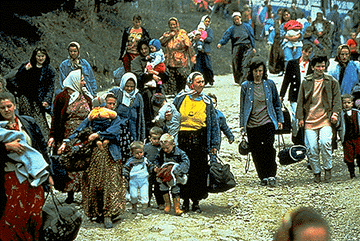
An additional 2.2 million citizens of Bosnia and Herzegovina of all ethnicities were displaced. The International Criminal Tribunal for the previous Yugoslavia (ICTY) has dominated the battle involved the Federal Republic of Yugoslavia (subsequently Serbia and Montenegro), as well as Croatia. Dozens of Bosnian Serb officers and soldiers have been convicted for his or her function in war crimes and crimes towards bosnian woman humanity in the course of the battle, as well as for the genocide in Srebrenica. Several high-ranking Croat and Bosniak officers have additionally been convicted. After the warfare, the Government of Bosnia and Herzegovina brought a lawsuit in opposition to Serbia before the International Court of Justice (ICJ), accusing the nation of genocide.
According to the 1953 census, Serbs have been within the majority in 74% of the territory of Bosnia & Herzegovina, and based on the census of 2013, Serbs are the majority on over 50% of Bosnia & Herzegovina. Their total quantity in 1953 was 1,264,372, that’s forty four.forty% of complete Bosnian population.
During World War II, Bosnian Serbs were put under the rule of the fascist Ustashe regime (supported by Bosnian Muslims) within the Independent State of Croatia. Under Ustashe rule Serbs along with Jews and Roma individuals, have been subjected to systematic genocide where lots of of 1000’s of civilian Serbs were murdered (significant disruption of the ethnic construction in favor of Bosnian Muslims). According to the US Holocaust Museum, 320,000–340,000 Serbs were murdered underneath Ustasha rule. Many historians and authors describe the Ustashe regime’s mass killings of Serbs as meeting the definition of genocide, together with Raphael Lemkin who is known for coining the phrase genocide and initiating the Genocide Convention.
The most notable proposal was the Vance-Owen Peace Plan, revealed in January 1993. The plan was presented by the UN Special Envoy Cyrus Vance and EC representative David Owen.
UN: Serbia failed to prevent Bosnian genocide
In Bosnia, Muslims represented the biggest single population group by 1971. More Serbs and Croats emigrated over the following two decades, and in a 1991 census Bosnia’s population of some 4 million was 44 % Bosniak, 31 % Serb, and 17 percent Croatian. This course of intensified after the mid-1980s with the rise of the Serbian chief Slobodan Milosevic, who helped foment discontent between Serbians in Bosnia and Croatia and their Croatian, Bosniak and Albanian neighbors.
Sexual violence through the Bosnian War
„Serbian Declaration on Srebrenica Massacre an Imperfect however Important Step“, International Center for Transitional Justice; accessed 19 May 2015. Evil Doesn’t Live Here, by Daoud Sarhandi and Alina Boboc, presents one hundred eighty posters created by Bosnian artist which plastered walls through the warfare.